Quick answer
Pavers usually outlast poured concrete on Sacramento clay because a paver field flexes with ground movement while a slab cracks. Concrete costs less up front and suits large simple areas, but a cracked slab is a replacement job while a settled paver field is a lift and relay.
Key takeaways
The honest answer to pavers or concrete is that both work, both fail the same way when they are built badly, and the ground under your garden matters more than the choice between them.
That said, on Sacramento clay there is a clear favourite, and it is worth understanding why rather than taking it on trust.
What Sacramento soil does to a patio
Much of the region sits on expansive clay. It takes on water in winter and swells. It dries out in summer and shrinks. The ground under your garden is slowly moving up and down through the year, and it does not move evenly, because one part of the garden drains differently from another.
Now put something on top of it.
Poured concrete is a single rigid plate. When the ground beneath it moves unevenly, the slab has two options: flex, which it barely can, or crack. So it cracks. Control joints are there to decide where, which is honest engineering rather than a fix, and cracks still find their own path often enough.
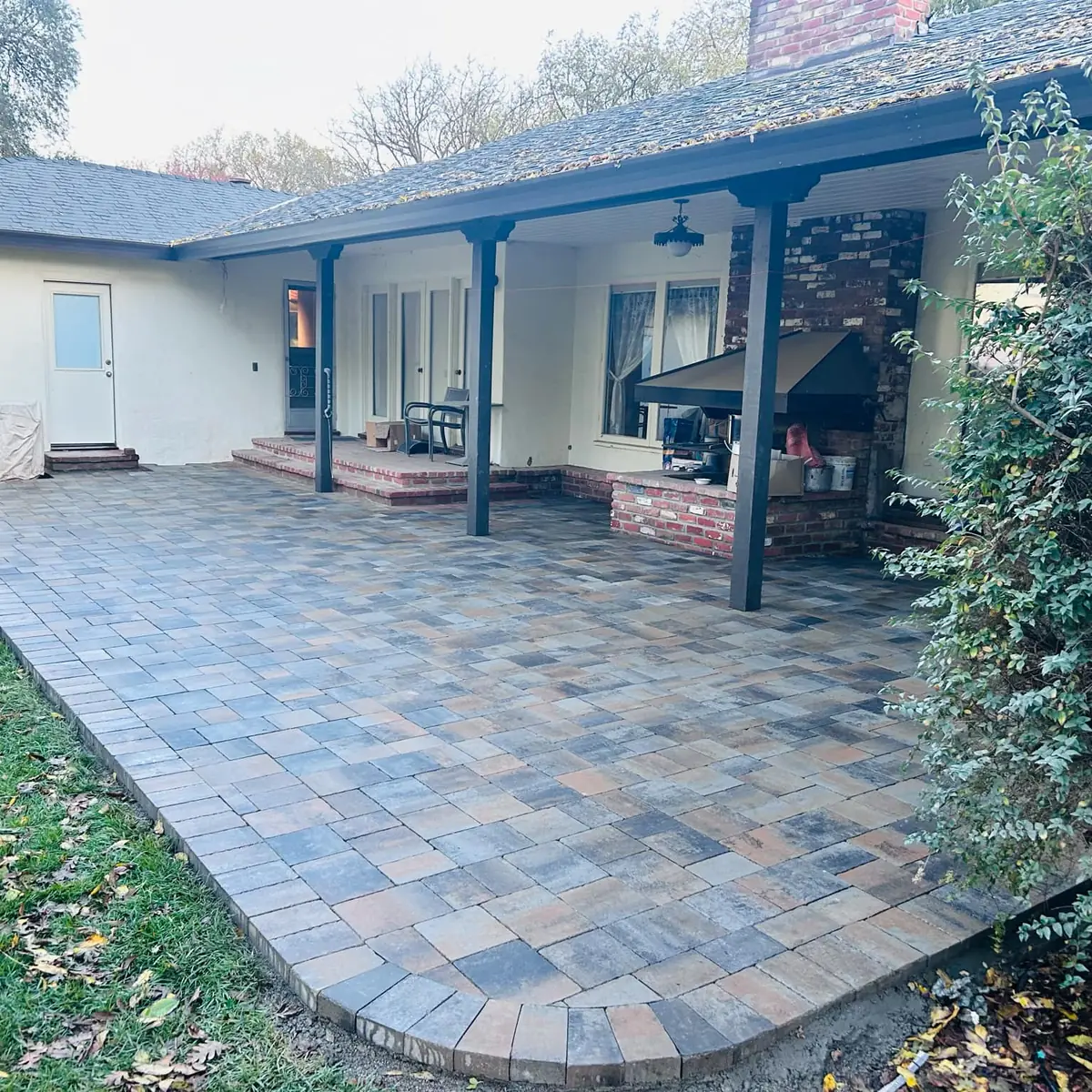
A paver field is not one thing. It is a few thousand small units bedded on sand over a compacted base. When the ground moves, the field moves with it. Individual pavers shift by a millimetre or two relative to each other and the surface stays whole. There is nothing rigid to crack.
The repair question, which is where the real difference sits
This is the part that usually settles the decision.
If a paver area settles in one corner, you lift the pavers in that corner, correct the base underneath, and relay the same pavers. Done properly the repair is invisible, because you are putting the original stones back down. It is a half day.
If a slab cracks, your options are to live with it, patch it in a colour that will never match, or break it out and repour. There is no clean middle. A crack in concrete is permanent in a way that a settled paver is not.
The same logic applies to anything buried. If an irrigation line, a drain or a conduit needs reaching under a paver terrace, you lift the stones, do the work, and put them back. Under a slab you are hiring a saw.
When concrete is genuinely the right call
Pavers are not always the answer and it would be dishonest to pretend otherwise.
Concrete makes sense when the area is large, simple in shape and not somewhere you look at closely. A big side yard, a utility area, a shed pad, a service path down the side of a house. The cost saving is real and the appearance matters less.
It also suits places wanting a genuinely seamless surface, and jobs where the budget only reaches one of the two. A well poured slab with a properly prepared base is a decent patio. A paver terrace laid on unprepared ground is not, whatever it cost.
What both of them actually depend on
Here is the thing that matters more than the material.
Both surfaces are only as good as what is under them. That means excavating to a real depth, laying an aggregate base, and compacting it in layers rather than all at once. Compaction is done in lifts because a compactor only densifies so far down. Six inches dumped in one go is loose in the middle no matter how long the plate runs over the top.
The base is invisible on handover day. It is also the most expensive part to do properly and the easiest to shortcut, which is why it is where cheap quotes are cheap. A paver patio on four inches of properly compacted base and a paver patio on two inches raked flat look identical on the day and diverge sharply within two winters.
When you compare quotes, ask each one for the excavation depth, the base depth and whether it is compacted in lifts. The answers tell you more than the paver catalogue does.
Heat, glare and what it feels like underfoot
A smaller point but a real one in a Sacramento summer. Large expanses of pale poured concrete throw a lot of glare and reflected heat back at the house, especially on a south or west facing elevation.
A paver field in a mid tone with a bit of colour variation reads softer, and the joints break up the reflection. It is not a dramatic temperature difference but it is a noticeable difference in how the space feels to sit on in August.
Where we land
For most Sacramento gardens, on clay, on a terrace people actually use and look at, pavers are the better long term surface. Not because they are fancier, but because they can be repaired and concrete cannot.
For a big plain utility area on a tight budget, concrete is the sensible answer and we will tell you so.
See terraces and patios for the work itself, or paving and driveways if the surface has to carry vehicles, which is a different base entirely.
A photograph of the space and a rough idea of what you want is enough to start. Request a consultation and we will come and stand in it with you.